The nervous system does not update automatically when danger passes. It updates when the body accumulates enough evidence that safety is real. Here is what that process actually looks like.
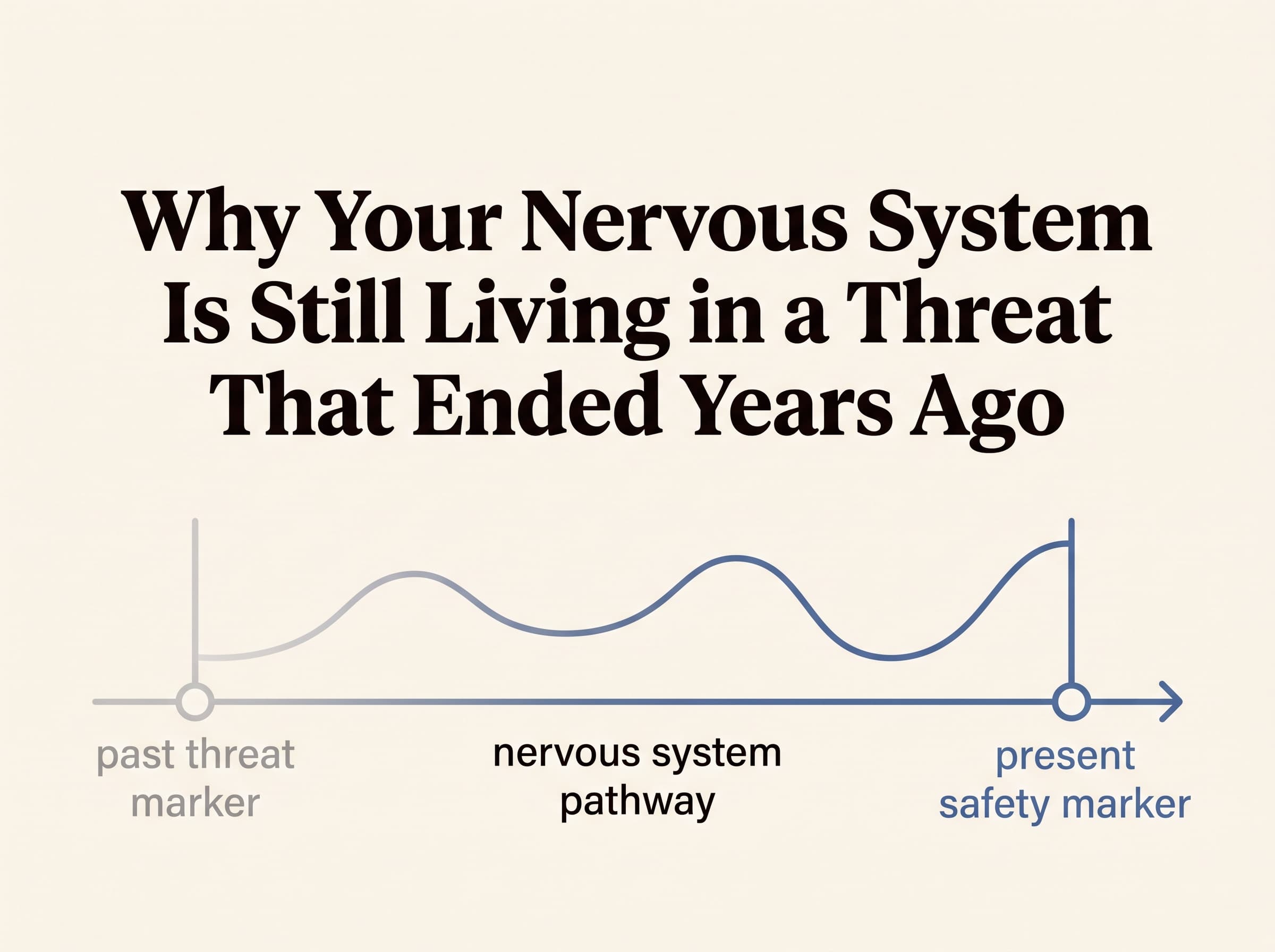
Why Your Nervous System Is Still Living in a Threat That Ended Years Ago
The traumatic experience is over. Objectively, verifiably, sometimes years or decades over. And yet the body responds to certain sounds, certain tones of voice, certain silences, certain smells as though the threat is still present and immediate.
This is not a failure of willpower. It is not irrationality. It is the nervous system doing exactly what it was designed to do — and doing it in a context the original design never accounted for.
Understanding why this happens, and what actually changes it, is the foundation of almost every effective trauma treatment developed in the last thirty years.
How the Nervous System Files Threat Information
The nervous system does not store threatening experiences the way a filing cabinet stores documents — neatly labeled, dated, and retrievable in organized sequence.
Threatening experiences are stored as sensory and physiological patterns. The smell, the sound, the quality of light, the physical posture of the body, the emotional tone of the environment. These elements are encoded together as a survival signature — a pattern the nervous system learns to recognize as the precursor to danger.
When any element of that signature reappears in the present environment, the nervous system activates the associated threat response before conscious awareness has a chance to evaluate whether the current context is actually dangerous.
This is the mechanism that makes trauma responses feel involuntary. They are involuntary, in the most literal neurological sense. The activation happens in the subcortical brain structures — primarily the amygdala — before the prefrontal cortex, the part responsible for rational evaluation and contextual judgment, has received the signal.
By the time you consciously register what is happening, your heart rate has already increased, your muscles have already tensed, and your body is already preparing for a threat that your conscious mind can clearly see is not present.
Why the Threat Response Does Not Simply Turn Off
A common and deeply understandable question from people living with trauma responses is some version of this: I know I am safe. Why does my body not know that?
The answer lies in how the nervous system distinguishes between intellectual knowledge and embodied knowledge.
Intellectual knowledge lives in the cortex. It is the part of you that can list the reasons you are safe, observe that the current situation is different from the past one, and construct a logical argument for why the threat response is disproportionate.
Embodied knowledge lives in the subcortical structures and the body itself. It is updated not through information but through accumulated direct experience. The nervous system learns that a context is safe the same way it learned the context was dangerous — through repeated exposure to the sensory and physiological pattern, followed by the absence of the anticipated threat outcome.
This is why telling someone who is having a trauma response that they are safe is insufficient. The cortex already knows. The part that is activating the response is not listening to the cortex.
In 2026, nervous system regulation is recognized as the clinical foundation of trauma healing — not a complementary technique but the primary mechanism through which the body updates its threat assessment and makes deeper psychological work possible.
The Three States the Nervous System Moves Between
Polyvagal theory, developed by Dr. Stephen Porges, provides one of the most clinically useful frameworks for understanding what is happening in a dysregulated nervous system.
The theory describes three primary states of nervous system activation.
The ventral vagal state is the state of safety and social engagement. In this state, the prefrontal cortex is online, rational thought is accessible, emotional regulation is available, and connection with others feels possible. This is the state in which learning, healing, and genuine relationship occur.
The sympathetic state is the mobilization state — fight or flight. Resources are redirected to survival functions. Heart rate increases, digestion slows, muscles prepare for action, and the capacity for nuanced thought and connection narrows significantly. This state is adaptive in genuine threat situations and problematic when it is chronically activated in safe environments.
The dorsal vagal state is the shutdown state — freeze, collapse, disconnection. This activates when the threat is assessed as too overwhelming to fight or flee from. The result is a kind of physiological withdrawal: numbness, dissociation, emotional flatness, difficulty engaging. This is the state that many people with chronic trauma histories spend significant time in without recognizing it as a threat response.
Most people living with unresolved trauma spend the majority of their time cycling between the sympathetic and dorsal vagal states, with limited access to the ventral vagal state where healing is actually possible. This is not a character failing. It is a nervous system that learned the ventral vagal state was unsafe and stopped returning to it.
What Actually Updates the Nervous System's Threat Assessment
This is the part of the clinical picture that is most consistently misunderstood, including by people who have been in therapy for years.
The nervous system's threat assessment updates through titrated exposure to the threatening context combined with a different outcome than the one originally learned.
This does not mean exposure without support or flooding the system with the feared stimulus. It means approaching the edge of the threat signature — close enough that the nervous system begins to activate — while remaining within a window of tolerance that allows the prefrontal cortex to stay online.
When this happens enough times, and when the outcome differs from the originally learned threat outcome, the nervous system gradually updates its assessment of that signature. The pattern that previously triggered an immediate survival response begins to lose its automatic activation.
This is the mechanism behind every evidence-based trauma treatment currently available. EMDR works by activating the trauma memory while simultaneously engaging bilateral stimulation, keeping the system within the window of tolerance. Somatic experiencing works by tracking and titrating the bodily sensations associated with the trauma response. Trauma-focused CBT works by combining cognitive reappraisal with graduated exposure to avoided stimuli.
The specific technique differs. The underlying mechanism is the same: the nervous system is guided to encounter the threat signature in a context where the outcome is survivable, until the signature and the threat response become decoupled.
Why This Takes Longer Than People Expect
The nervous system learned the threat signature through repetition — multiple experiences of the same pairing of sensory pattern and dangerous outcome. It updates through the same mechanism. There is no single corrective experience that rewires the entire pattern, just as there was no single experience that created it.
This is the honest answer to the question most people bring to trauma therapy eventually: how long is this going to take?
The answer is that it depends on several factors.
- The depth and duration of the original trauma exposure
- The age at which the threat learning occurred, with earlier learning being more deeply embedded
- The relational context of the healing, since the nervous system co-regulates with other nervous systems and heals most effectively in safe relationship
- The consistency of the therapeutic work and the degree to which the window of tolerance can be maintained during the process
What is reliably true is that the process is non-linear. There will be weeks that feel like significant progress followed by weeks that feel like regression. The regression is almost always the nervous system encountering a new layer of the same underlying pattern rather than undoing the work that came before.
For a deeper look at the specific regulation practices that support nervous system healing and how to apply them in daily life, visit therapistwords.estorealm.com.
Frequently Asked Questions
Why do trauma responses feel so out of proportion to the current situation?
Because the nervous system is not responding to the current situation. It is responding to a pattern match between the current sensory environment and the stored threat signature. The response is perfectly proportionate to the original threat. It is disproportionate to the present one because the present one is not actually the original threat — it just shares enough sensory or emotional features to trigger the same response.
Is it possible to heal a nervous system that has been dysregulated for decades?
Yes. Neuroplasticity — the brain's capacity to form new neural connections — continues throughout the lifespan. The process is slower with longer-standing patterns and requires more consistent and sustained intervention, but the capacity for nervous system update does not close. Research on older adults receiving trauma treatment consistently shows meaningful improvement even when the original trauma occurred many decades earlier.
What is the difference between nervous system regulation and trauma processing?
Regulation refers to the capacity to move between nervous system states — to come down from sympathetic activation or up from dorsal vagal shutdown and return to the ventral vagal window of tolerance. Processing refers to working through the stored threat memory itself so that it loses its automatic activation. Both are necessary. Regulation creates the conditions under which processing becomes possible. Processing without adequate regulation can retraumatize rather than heal.
Why does stress in the present sometimes make old trauma responses stronger?
Current stress loads the nervous system and narrows the window of tolerance. When the window is narrowed, less activation is required to push the system into a sympathetic or dorsal vagal response. This is why trauma responses that have been relatively quiet can flare significantly during periods of life stress — not because the trauma has gotten worse but because the available regulatory capacity has temporarily decreased.
Can self-directed practices actually update the nervous system or does this require a therapist?
Self-directed practices including breathwork, somatic movement, cold exposure, and mindfulness can meaningfully support nervous system regulation and build the tolerance window. They are genuine contributions to the healing process. The component that is more difficult to replicate outside of a therapeutic relationship is the co-regulatory aspect — the experience of the nervous system learning to feel safe in proximity to another regulated nervous system. For trauma with significant relational roots, this co-regulatory experience is often a necessary part of the process that self-directed practices alone cannot fully provide.
This article is for educational purposes only. TherapistWords is not a licensed clinical practice and this content does not constitute therapy or clinical advice. If you are experiencing trauma symptoms that significantly impact your daily functioning, please reach out to a qualified mental health professional.
More from TherapistWords
The Anxiety Cycle That Keeps Itself Going (And the One Thing That Breaks It)
Anxiety does not sustain itself through the original threat. It sustains itself through the behavior the threat produced. Understanding this distinction changes everything about how anxiety is treated.
What Actually Happens in Therapy (That Nobody Explains Before You Start)
Most people enter therapy with a picture of what it will be like that does not match what effective therapy actually involves. The gap between expectation and reality is one of the primary reasons people leave before the work gets traction.
The next therapistwords essay in your inbox.
One careful letter, every Sunday. Free.